Real Estate Investment Manager: One Set of Numbers, and an Assistant That Can Answer From Them
Ongoing engagement, 2026 · Data platform architecture & AI engineering
Real estate investment management
A US real estate investment manager had a property management system, fund spreadsheets and a shared drive of agreements that each told a different story. I built the platform that makes them agree, and the assistant their team asks instead of waiting a week for an analyst.
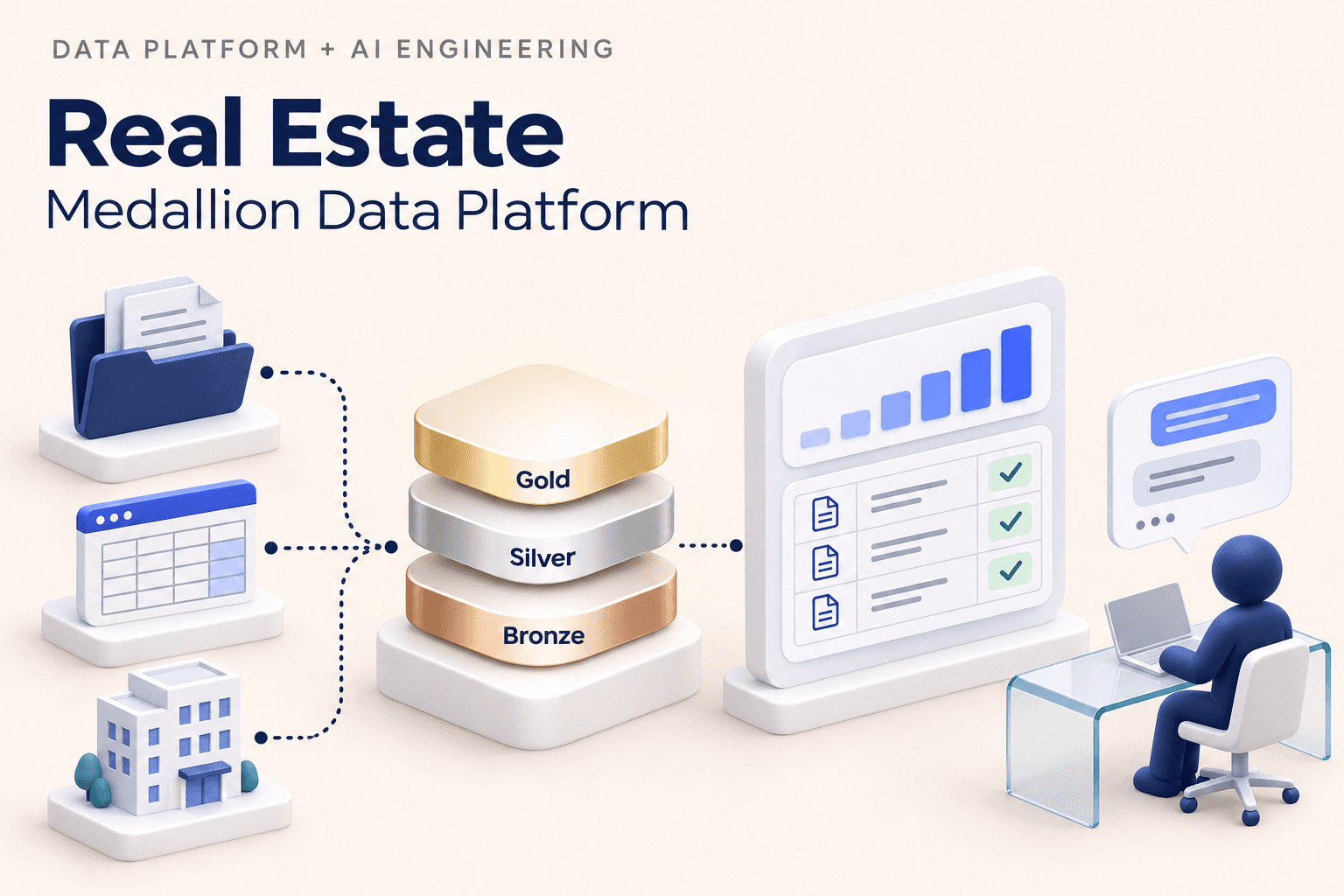
Concept illustration
The client is a US real estate investment manager with funds, properties and investors to report to. Under NDA, so the name and anything that would identify them stay out. They had systems of record but no single place where the numbers agreed: the property management system held rent and occupancy, the fund models and covenants lived in spreadsheets owned by one person each, and the loan, lease and investor agreements sat as PDFs on a shared drive. The board wanted AI. The CFO wanted a number they could trust first.
Three sources gave three answers to the same question, and the one that reached investors was whichever somebody typed last. Any real question cost a week of an analyst's time, so most questions were never asked. Quarter end took weeks and still shipped with corrections. The firm was being pitched two-year data programmes with a team of five, and had already seen one AI pilot that could not say where its answers came from. The ask was to prove, on their own data, that there was a shorter way: one set of numbers, questions answered the same day, and an assistant that cannot see what the person asking cannot see.
Solution
- Picked one part of the business and wrote down what done meant
Started with a short scoping phase instead of a platform programme. Chose the reports the finance team already trusted as the acceptance test: the platform would be done when it reproduced them, line for line, from the source systems. Listed the questions the investment team wanted answered and the sources each one needed. That paper was what the sponsor approved.
- Built a medallion lakehouse on Microsoft Fabric
Landed the property management system, the fund spreadsheets and the finance system into a bronze layer exactly as received, cleaned and reconciled them in a silver layer, and shaped a gold layer around the firm's own vocabulary: fund, property, lease, investor, period. Every row carries where it came from and when, so a number can be traced back to the source that produced it.
- Made the three answers agree
Most of the first weeks went on finding out which of the three rent numbers was right and why the others differed. Each difference became a rule in the silver layer, written down and reviewed with the finance team. Once the reports matched, the rules became the firm's definitions, not one person's memory.
- Put the agreements inside the same system
Loaded the leases, loan documents and investor agreements alongside the numbers, split into clauses with the document, page and section kept with every piece. Questions like which loans carry a change-of-control clause stopped being a week of reading and became a query with the source attached.
- Built the assistant on top, read-only and cited
Connected a large language model to the reporting layer so the investment team can ask a question in plain English and get an answer with the figures, the report it came from and the clause it rests on. The assistant reads, it never writes. It answers only from the governed layer, so it cannot invent a number that is not in the data.
- Bound every answer to the person asking
Access runs through the same permissions the firm already manages. A person who cannot open a fund's investor list cannot get it out of the assistant either, and the audit trail records who asked what. This was the CFO's real condition for letting anything called AI near investor data.
Trade-offs I'd defend
The temptation was to start with the assistant, because that was what the board wanted to see. I held the order: trusted numbers first, then the assistant on top of them. An assistant over disputed data would have been a faster demo and a slower project.
Ingestion from the firm's own systems was built with their IT lead so it can be maintained without me. I owned the architecture, the silver rules, the definitions and the AI layer, which is where the judgement sits.
The assistant is tuned to say where a number came from and to say when it cannot answer from the data. A model that will always produce something is the wrong tool for a finance team. Trust came from the citations, not from the fluency.
Inside the solution
Illustrations of the product decisions and engineering workflow, recreated for this case study.
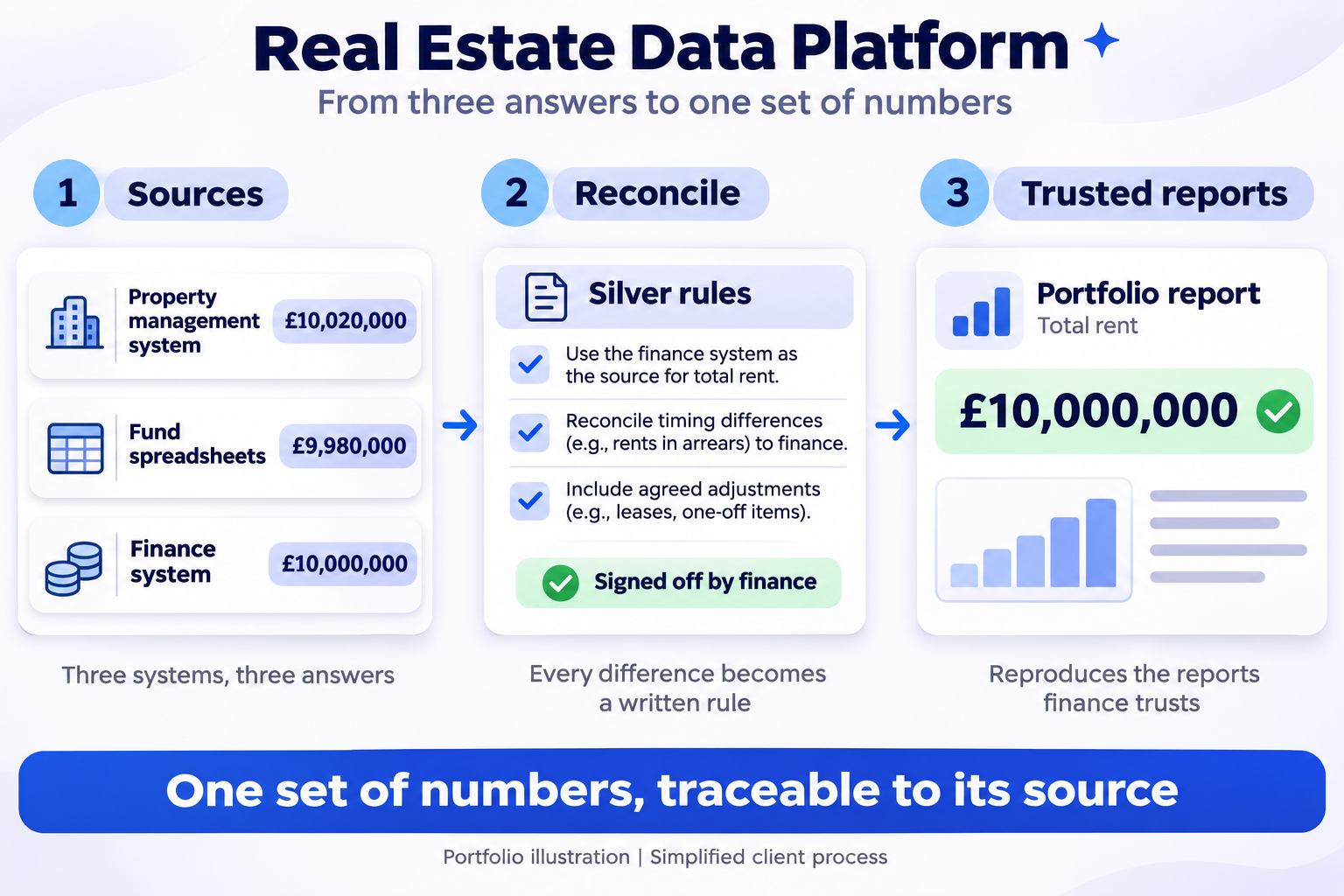
From three answers to one set of numbers
The property management system, the fund spreadsheets and the finance system each gave a different answer. Every difference became a written rule in the silver layer, agreed with finance. The platform passes when it reproduces the reports finance already trusts. Figures are illustrative.
View full-size image (new tab)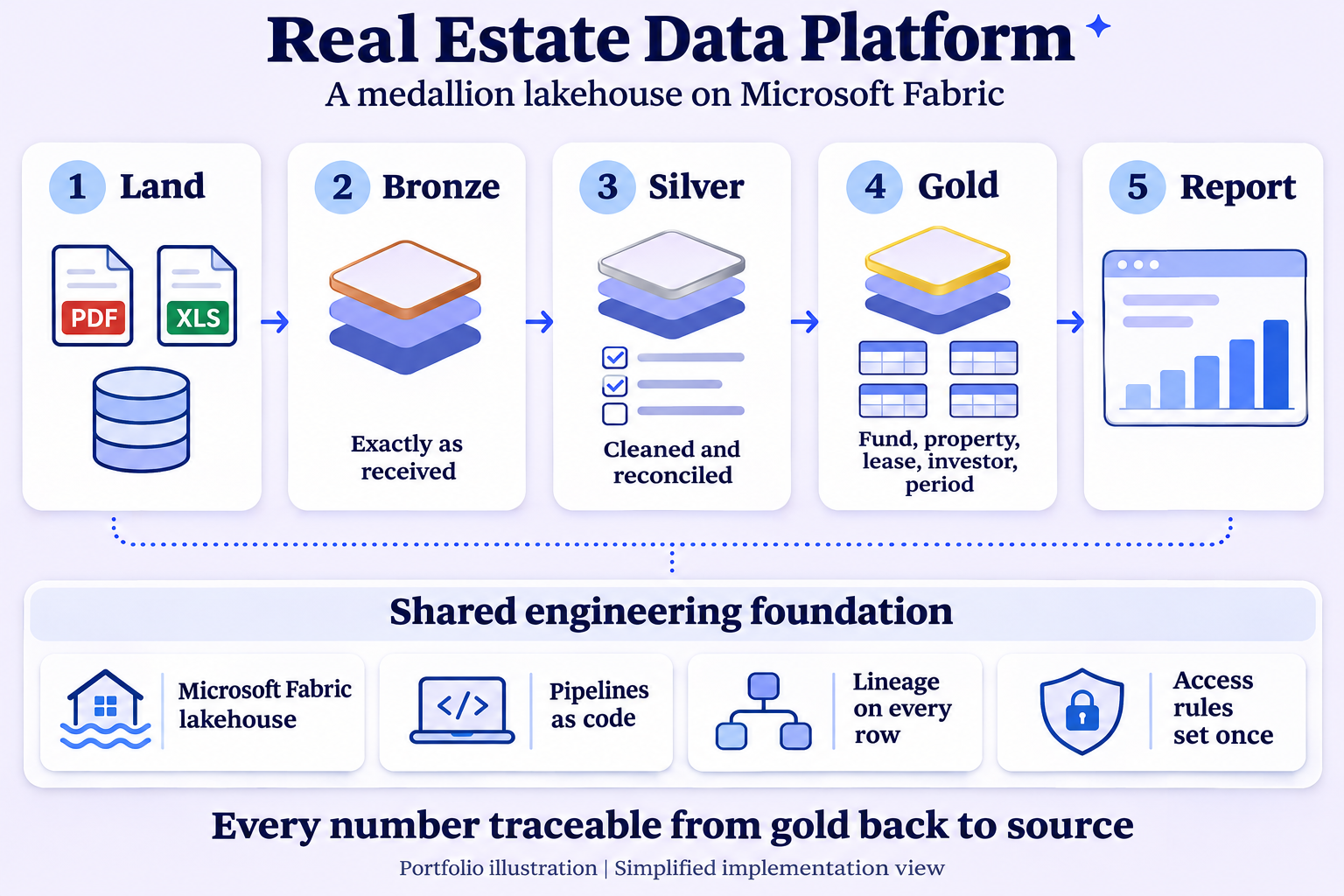
A medallion lakehouse on Microsoft Fabric
Bronze keeps every source exactly as received. Silver cleans and reconciles it. Gold is modelled in the firm's own vocabulary. Pipelines are set up as code, every row carries its lineage, and access rules are set once.
View full-size image (new tab)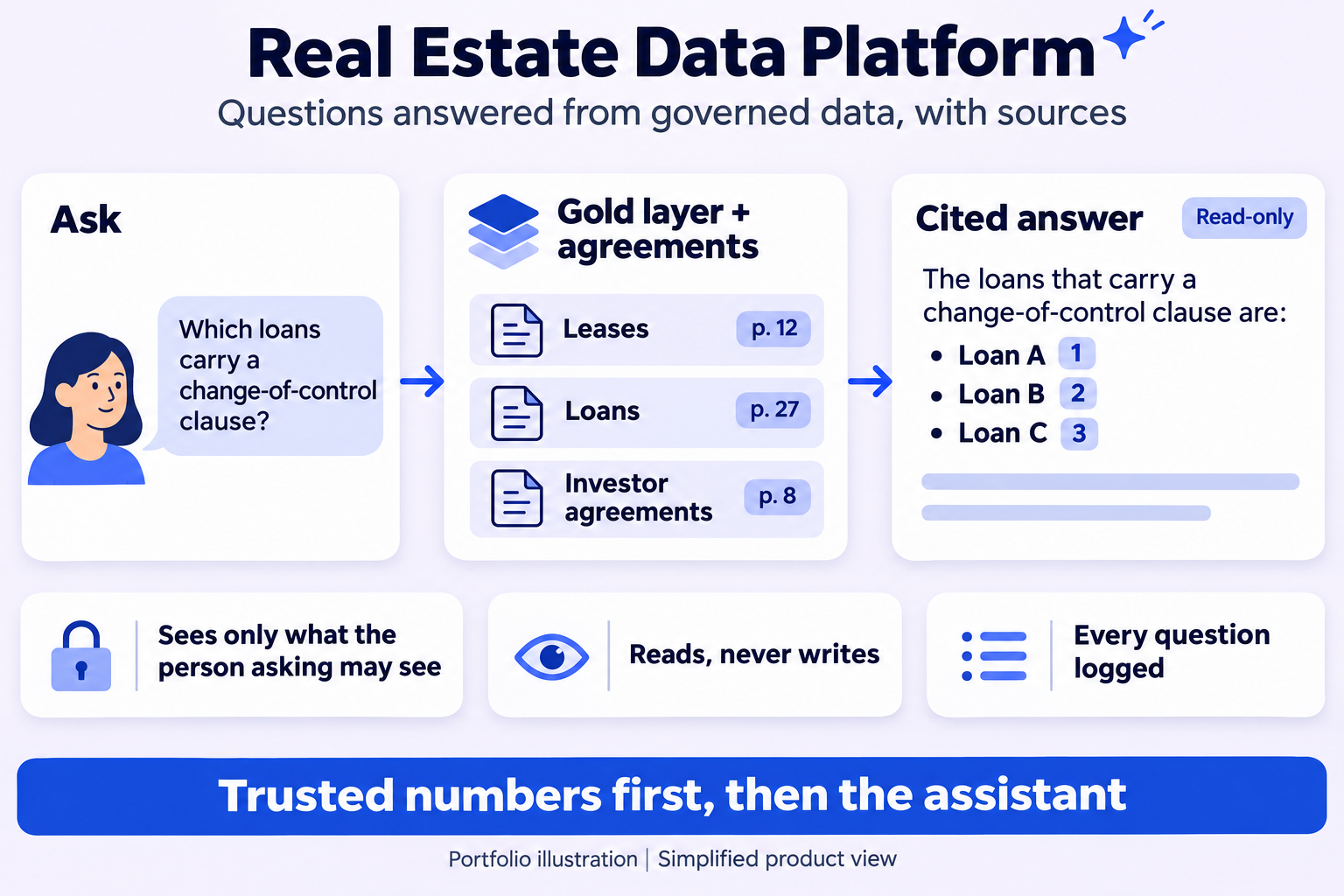
Questions answered from governed data, with sources
The assistant reads the gold layer and the firm's agreements, never writes, and cites the page each answer rests on. It sees only what the person asking may see, and every question is logged.
View full-size image (new tab)Outcomes
A second part of the business is a second run on the same platform: the definitions, permissions and assistant are already in place, so the next domain starts with bronze, silver and gold already in place rather than at zero.
Work of this shape starts with Phase Zero: three weeks, a fixed fee, and a paper written for your steering group — with a proof on your own data where there is something to prove.
Specialist engineering for larger companiesMore case studies
Led discovery, product definition and engineering for an AI procurement platform, translating buyer and supplier needs into 39 feature specifications and evidence-linked bid evaluation.
Turned supply-chain rules into explainable allocation recommendations, built planner validation tools, and contributed AI-assisted process discovery.
Defined and delivered an ERP from scratch, from automated quotes to dispatch across nine industrial machines worth £2M+, and established the client's software department.
Improved the everyday agent experience and shaped a phased production architecture, connecting reliability, customer isolation and infrastructure spend to product needs.
Clarified 37 assigned requirements for a manufacturing-services delivery platform and established an isolated AWS development environment for stakeholder QA.
Corporate + investor-relations website — CMS-driven, internationalized across 10 locales, with 3D/WebGL brand experiences.
A build you can't evaluate, a demo that has to ship, or a certificate a contract is waiting on.
Book a 30-minute discovery call. Bring what you're building, the decision you need help with, and your timeframe. We will check fit and agree the next step before any paid work.