The Twelve-Week Build
Most 'MVP' engagements stop at a demo. I build the fully-complete, production-grade version — architected properly, shipped to real infrastructure, and handed over in a state your team can run without me. One person accountable from the product decision through to the production deploy, not a relay race across four different contractors.

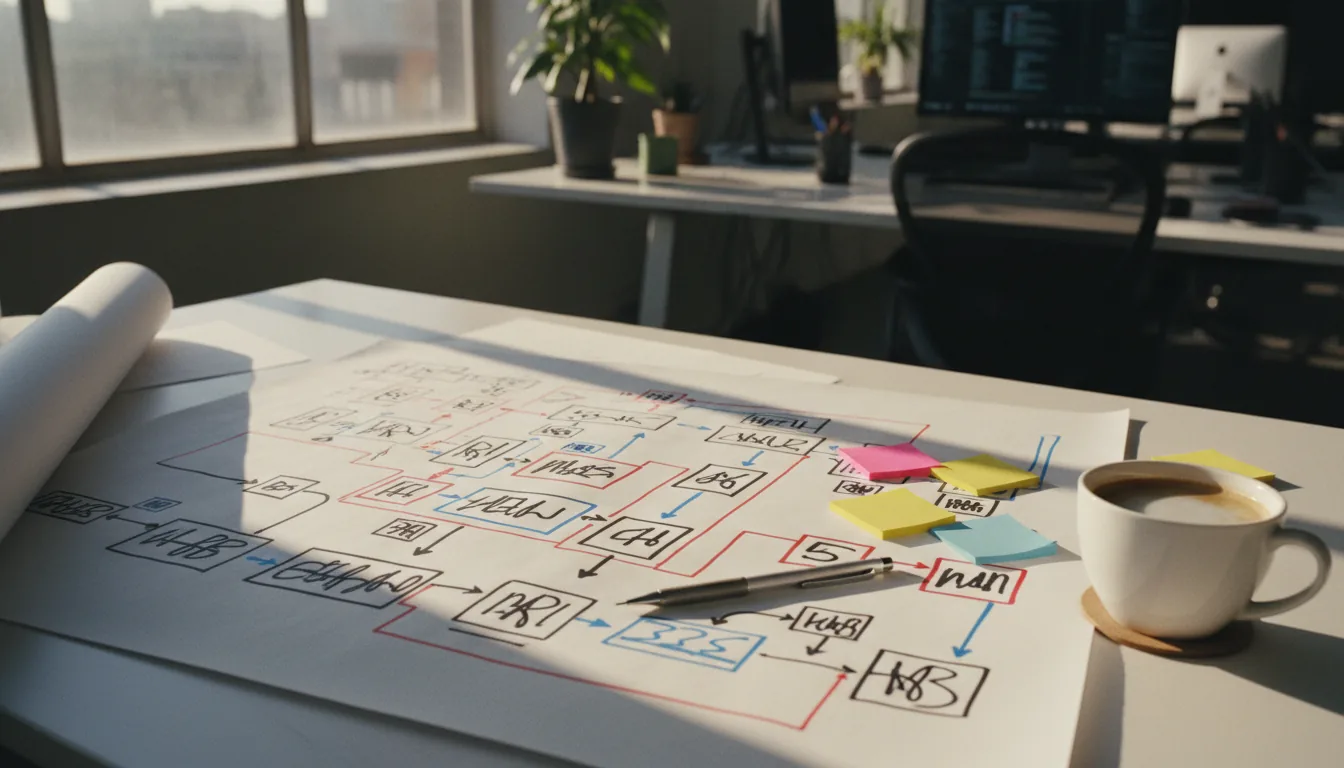
The Build Plan
- What is kept from what you already have, and what gets rebuilt
- Scope, and — more usefully — the exclusions written down
- Who owns what: accounts, repositories, domains, keys
- A date, and the decisions you have to make for that date to hold
- A price, structured as milestones you can stop after
It is the document I tell every founder to demand from every supplier — including me. You can take it to any of them.
If you build with me it starts within the plan's 30-day window and the plan is credited. If you build with someone else, you are holding a brief they can quote against.
- Discovery and prioritisation tied to outcomes, not feature requests
- Platform and domain design — monolith, modular monolith, or service-oriented, chosen for the stage
- Architecture decision records on every load-bearing call, so the reasoning survives me leaving
- Full-stack delivery: TypeScript/Node, Python, Java; React and Next.js; PostgreSQL and Redis
- Data platforms on Microsoft Fabric and Azure — PySpark pipelines, medallion lakehouse, a semantic layer product and AI features both query
- AI features built properly: model selection, fine-tuning, RAG, and agent orchestration, with eval harnesses so they don't regress silently
- Terraform-first infrastructure-as-code across AWS, Azure, or GCP — cloud-agnostic by default
- CI/CD with preview environments, observability, and SLOs wired in from the first deploy
- Delivery rhythm and DORA metrics set up to survive without me in the room
Blank team vs an embedded production engineer
The ranges below are what each stage typically takes from a standing start. Working with me compresses them because architecture, build, and infrastructure run as one accountable thread instead of handoffs between separate hires.
No handoff between product, build, and infrastructure roles — nothing waits in a queue between phases the way it does across separate hires or contractors.
No ramp period. Full-pace contribution from the first sprint, on a stack I'm also accountable for running afterwards.
IaC, CI/CD, and observability get built alongside the feature work, so 'production-ready' is true on day one rather than a separate project bolted on at the end.
Ranges assume a single product surface on a green-field or lightly-established codebase. A large legacy migration or several parallel surfaces push every figure to the right.
A build that's stalled, an architecture call you can't get wrong, or an AI feature that needs to leave the prototype stage — tell me where it stands.
- Weeks 1–2
The Build Plan
- What gets kept and what gets rebuilt, decided in writing rather than discovered later
- Scope, and just as importantly the exclusions
- Who owns the accounts, the repos, the domains and the keys — set up in your name before any code is written
- A date, and a price expressed as milestones you can stop at
- Weeks 3–10
The build
- A working skeleton deployed to your own infrastructure by the end of week two of the build — the first checkpoint you can see rather than be told about
- Milestones you can stop at, each one demoable on your own environment
- Infrastructure, CI/CD and observability shipped alongside the features, not bolted on at the end
- Data and AI features shipped with eval harnesses, so "it works" is measured rather than asserted
- Weeks 11–12, plus 30 days
Handover
- Runbooks, ADRs and the delivery playbook written for the team that inherits it
- A named owner on your side, and a handover signed off in writing
- Thirty days after the last deploy for defects in what I built, as service rather than cash
- Everything portable: another supplier could pick it up without calling me first
- Architecture review + ADRs for the load-bearing decisions
- Production system live on your infrastructure, under CI/CD
- Data or AI features shipped with eval harnesses, not just a demo
- Delivery playbook and metrics dashboard your team owns after I leave
A fixed shape: two weeks to The Build Plan, ten weeks building against it, then thirty days of handover after the last deploy. Billed as stoppable milestones rather than a monthly retainer. Larger scopes run as consecutive builds on the same shape — never as an open-ended engagement.
Passes diligence, or I fix it.
If a third-party investor's or acquirer's technical diligence in the twelve months after handover raises a finding against work I delivered, I fix it at no charge.
- Up to five working days of remediation, delivered as work rather than refunded as cash.
- Covers what I built — not changes made after handover, and not business decisions.
- The first working version is live on your own accounts by build week two, or the first build invoice waits until it is.
- Milestone billing throughout. You can stop after any phase.
Questions I get asked about this.
Do you write the code yourself, or manage a team that does?
Both, depending on scope. I ship production code every week myself — that keeps the architecture honest, because I'm also the one accountable for living with it. Where there's an existing team, I work alongside them rather than replacing them.
What if I already have engineers?
Then I plug into the gaps — usually architecture ownership, the AI or data layer, or infrastructure that's been deferred too long. I'm not there to duplicate a working team, only to own the parts that need a senior, accountable hand.
Is this different from hiring a dev agency?
An agency bills hours and hands you a deliverable. I own outcomes on infrastructure I'm also responsible for handing back to your team in a state they can run — architecture decisions documented, CI/CD in place, no bus-factor of one held outside the company.
Do you handle the AI/data parts specifically, or just general engineering?
Both, on the same platform. Data pipelines, model selection, RAG, and agent work go through the same production discipline as the rest of the build — eval harnesses, observability, and rollback paths — not a separate proof-of-concept that never gets hardened.
More services
View all →The CTO Seat
You are the one who signs off the spend. This is the seat that shows you the working. Technical direction owned, the team unblocked, fundraising and hiring run as workstreams, and a technical voice that answers to your board rather than to a supplier.
The Certification Ladder
Get certified, not just "ready". Cyber Essentials, then Cyber Essentials Plus, then ISO 27001 with ISO 27701 in one combined audit, and ISO/IEC 42001 when AI is in scope — each rung a certificate in its own right, and each one the groundwork for the next.
A build you can't evaluate, a demo that has to ship, or a certificate a contract is waiting on.
Book a 30-minute discovery call. If we're not a fit, I'll tell you on the call — and point you toward someone who is.