Everwise: AI Procurement Platform
Product & engineering leadership · Fractional CPO / CTO
AI procurement / buyers & suppliers
Owned product and engineering together: discovered what buyers and suppliers needed, shaped the roadmap, tested ideas through prototypes and built AI-assisted evaluation with human accountability.
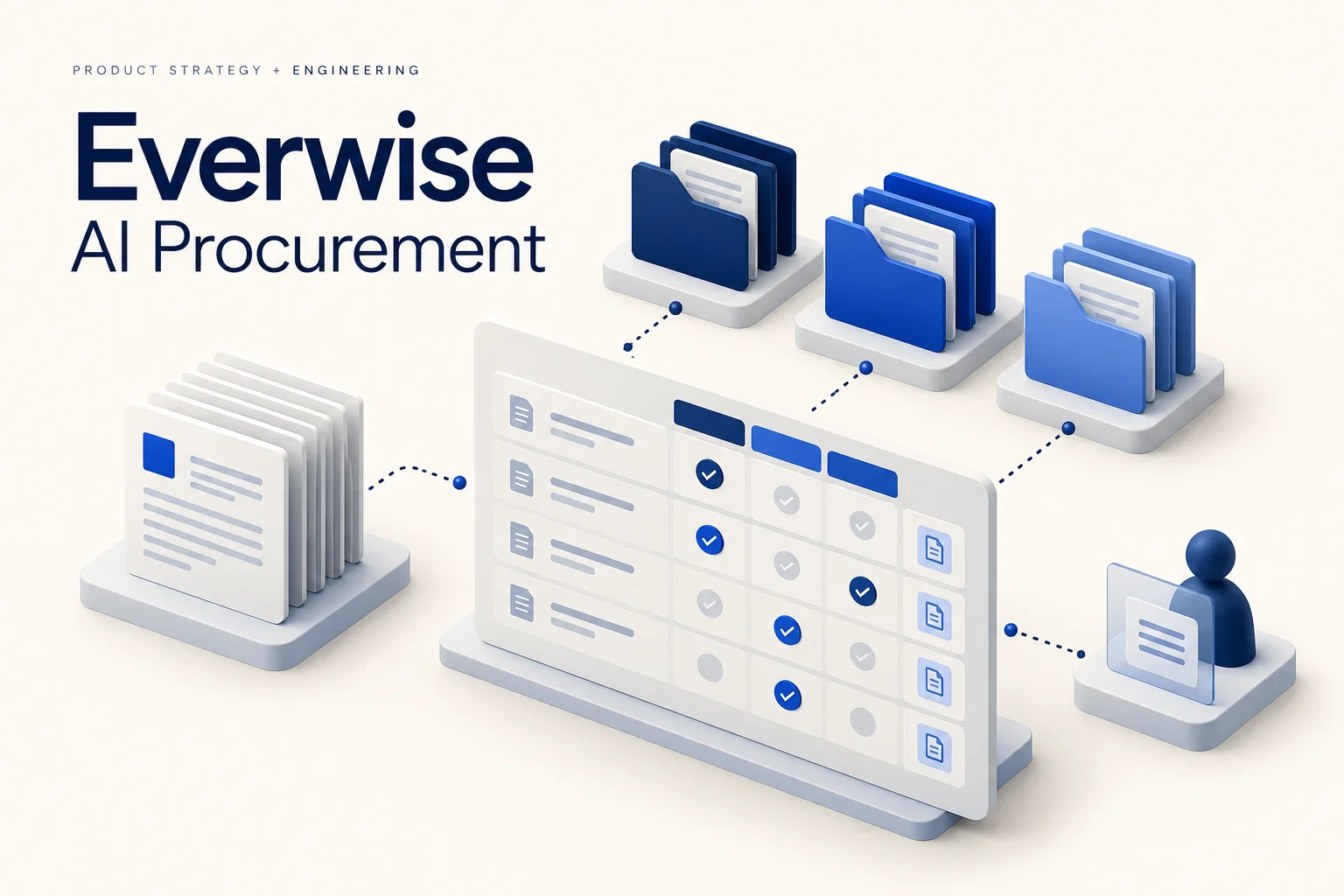
Concept illustration
Key Performance Indicators
- Features Specified With Business Analysis and Solution Designs
- 39
- AI Model Configurations Benchmarked
- 7
- Synthetic Test Cases in the Offline AI Benchmark
- 240
These figures measure product definition and offline evaluation scope. Feature specifications are not a count of shipped features, and synthetic tests are not production accuracy results.
Everwise is an AI procurement platform for buyers and suppliers. As Fractional CPO / CTO, I worked across product, design, engineering, AI, hiring and analytics. The product had to support different participants in a procurement process while keeping evaluation decisions understandable and reviewable.
Everwise needed to turn a broad AI procurement vision into a focused product for buyers and suppliers. Buyers needed defensible bid evaluations; suppliers needed simpler response workflows. As Fractional CPO / CTO, I had to prioritise competing needs, validate the experience with customers and ensure AI recommendations were explainable and subject to human review.
Solution
- Turned customer discovery into an actionable product definition
Ran workshops with buyers and suppliers and translated findings into personas, user journeys, stories and acceptance criteria. Wrote the e-sourcing PRD, competitive analysis and specifications for 39 features, each with a business analysis and solution design.
- Sequenced the roadmap around dependencies
Prioritised the initial feature set into four delivery phases: foundation, core procurement, AI and integrations, then scale and compliance. Used this sequence to make the path through a broad product scope explicit.
- Used prototypes to change the experience early
Built high-fidelity React and TypeScript prototypes and put them in front of customers. Feedback that bid forms felt cramped led to a full-screen, question-by-question writing flow. Prototyped framework workflows and evaluation rubrics before committing the entire scope to implementation.
- Built AI evaluation around evidence and human sign-off
Implemented document processing, retrieval and source-linked answers alongside evidence-linked scoring. Added review states for missing evidence, score variation and consensus, with mandatory human sign-off before evaluation decisions were finalised.
- Evaluated AI as a product choice
Built an offline benchmark across seven model configurations and 240 synthetic test cases, comparing answer quality, missing responses, latency and cost. Used a controlled evaluation to examine trade-offs without presenting synthetic results as customer performance.
- Delivered the foundations and handover for the next team
Built the multi-tenant API, Azure infrastructure and delivery pipelines. Remediated external penetration-test findings with retest evidence, and prepared role-specific handover material across engineering, QA, security and operations.
Trade-offs I'd defend
Kept evidence visible and required human sign-off. Confidence and review states help an evaluator decide where to investigate instead of treating an AI score as a final answer.
Explored complex framework and scoring journeys through prototypes, then separated that discovery from the implementation roadmap. This allowed customer feedback to change the experience before the full scope was built.
Inside the solution
Illustrations of the product decisions and engineering workflow, recreated for this case study.
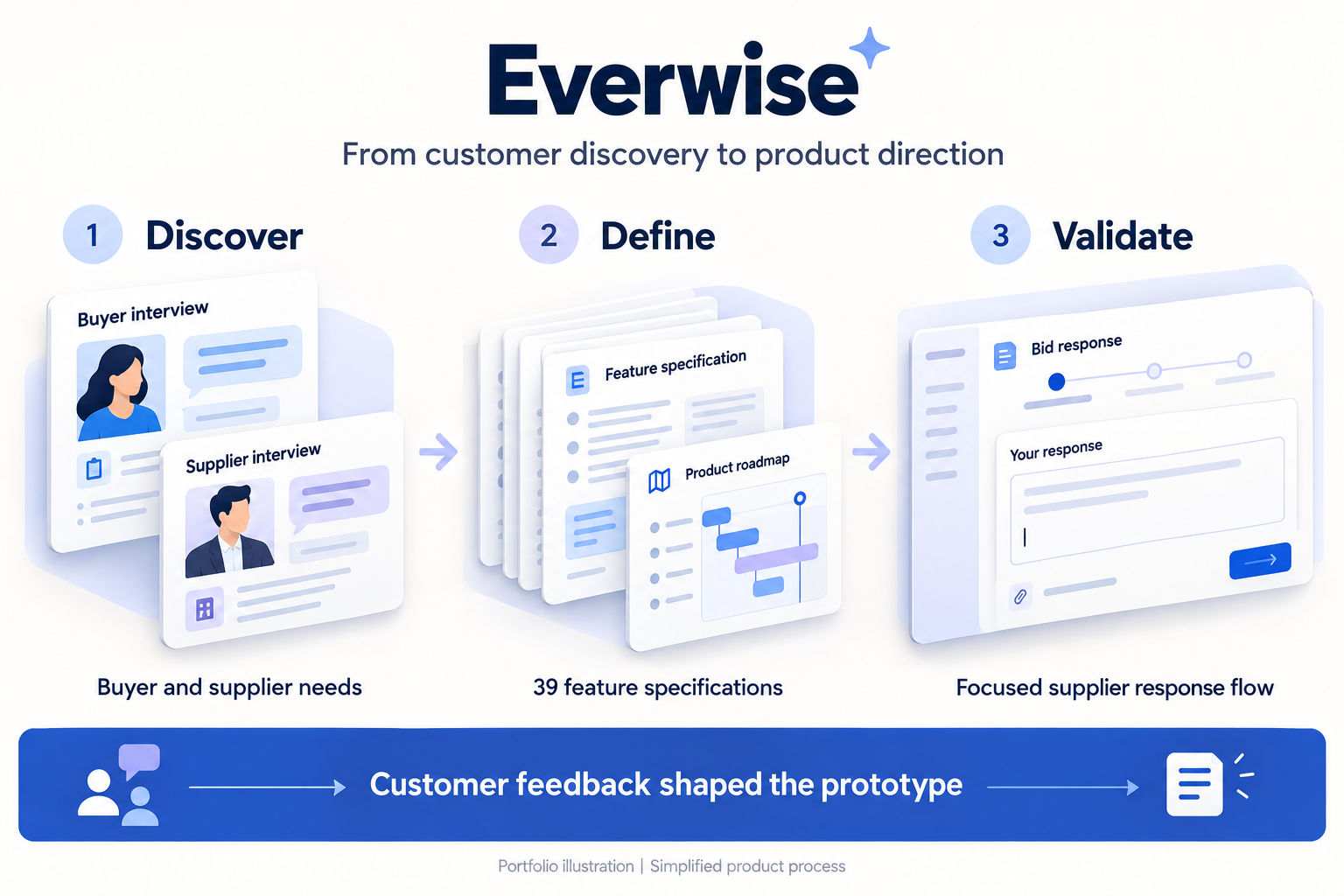
From customer discovery to product direction
I translated buyer and supplier discovery into feature specifications and a phased roadmap. Customer feedback shaped a more focused supplier response prototype. The 39 specifications describe defined scope, not 39 shipped features.
View full-size image (new tab)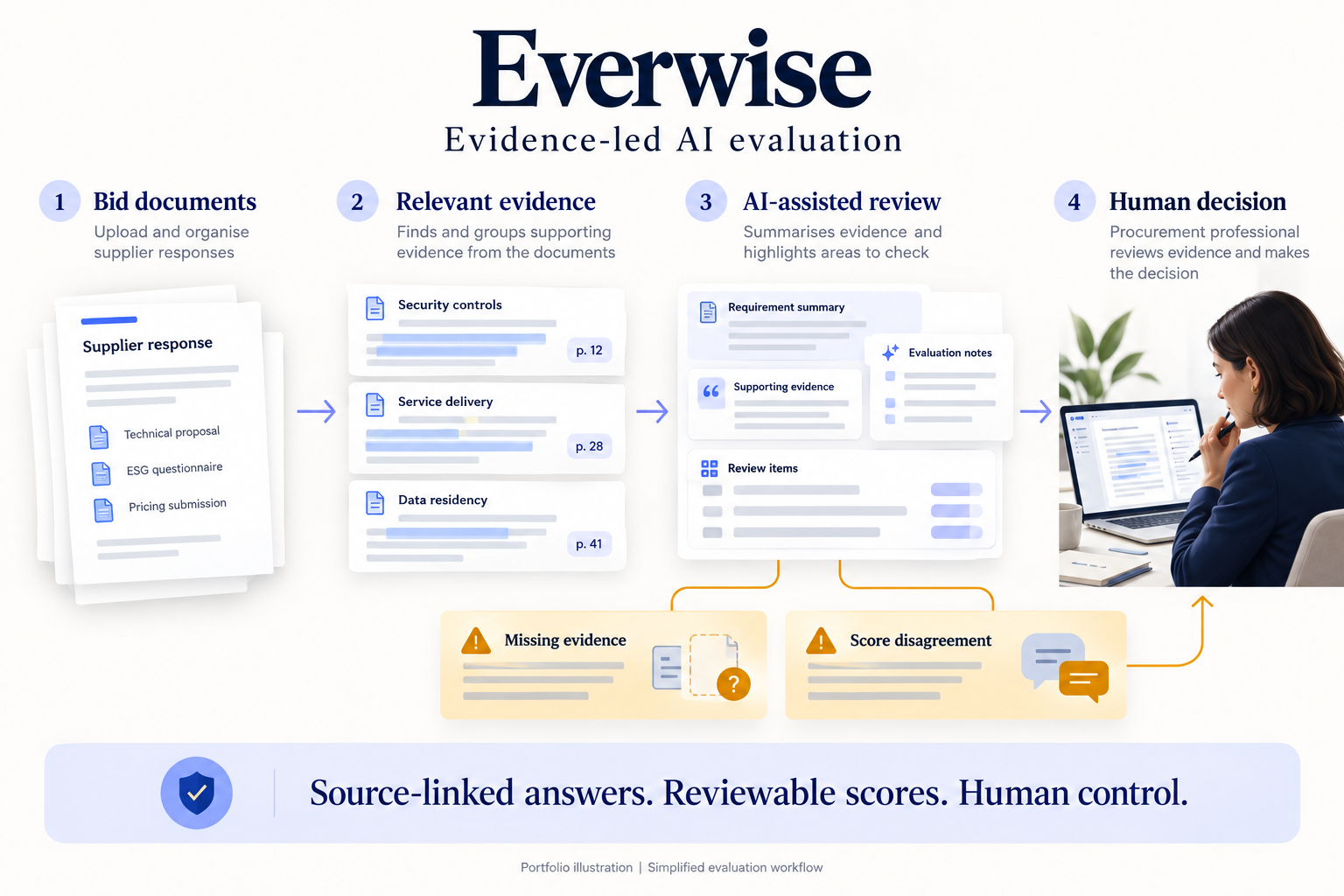
Evidence-led AI evaluation
I connected AI-generated answers and scores to source evidence, with review states for missing evidence and evaluator disagreement. Human review and sign-off keep procurement decisions accountable.
View full-size image (new tab)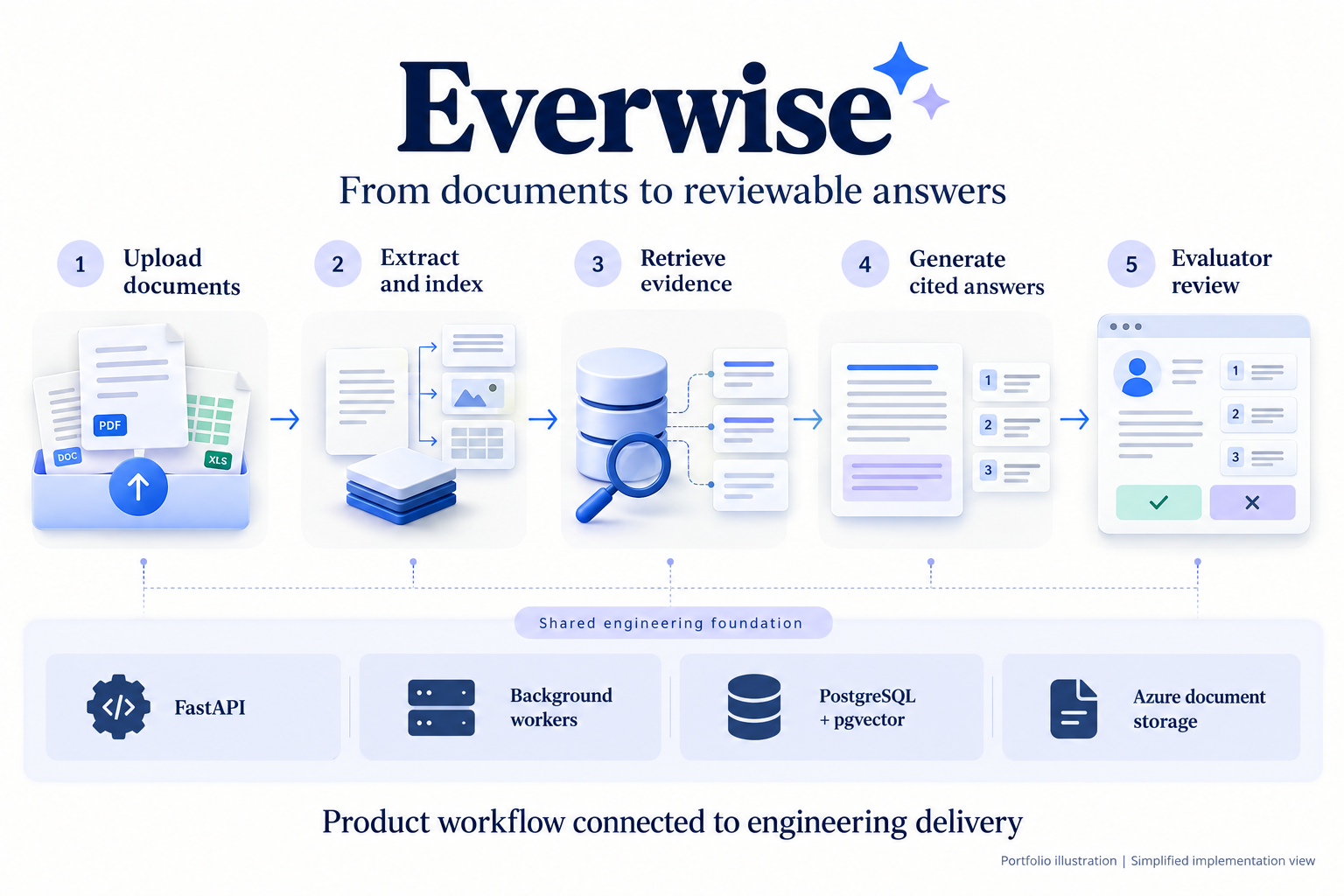
From documents to reviewable answers
I built the API and document-processing foundations that connect uploaded bids to source-linked answers. Background workers handle ingestion, PostgreSQL with pgvector supports retrieval, and Azure storage holds documents.
View full-size image (new tab)Impact
I translated discovery into 39 feature specifications with business analysis and solution designs, organised into four delivery phases. This gave the team a concrete basis for prioritisation, implementation and handover. Customer feedback directly changed the prototype from cramped bid forms to a full-screen, question-by-question writing flow.
The evaluation implementation linked answers and scores to evidence and required human sign-off, giving reviewers a way to investigate missing evidence and inconsistent scores. An offline benchmark compared seven model configurations across 240 synthetic test cases to inform quality, latency and cost decisions. I also remediated external penetration-test findings with retest evidence. The result connected customer needs, product decisions and engineering delivery while keeping procurement judgement with the evaluator.
More case studies
Turned supply-chain rules into explainable allocation recommendations, built planner validation tools, and contributed AI-assisted process discovery.
Defined and delivered an ERP from scratch, from automated quotes to dispatch across nine industrial machines worth £2M+, and established the client's software department.
Improved the everyday agent experience and shaped a phased production architecture, connecting reliability, customer isolation and infrastructure spend to product needs.
Clarified 37 assigned requirements for a manufacturing-services delivery platform and established an isolated AWS development environment for stakeholder QA.
Corporate + investor-relations website — CMS-driven, internationalized across 10 locales, with 3D/WebGL brand experiences.
A build you can't evaluate, a demo that has to ship, or a certificate a contract is waiting on.
Book a 30-minute discovery call. If we're not a fit, I'll tell you on the call — and point you toward someone who is.